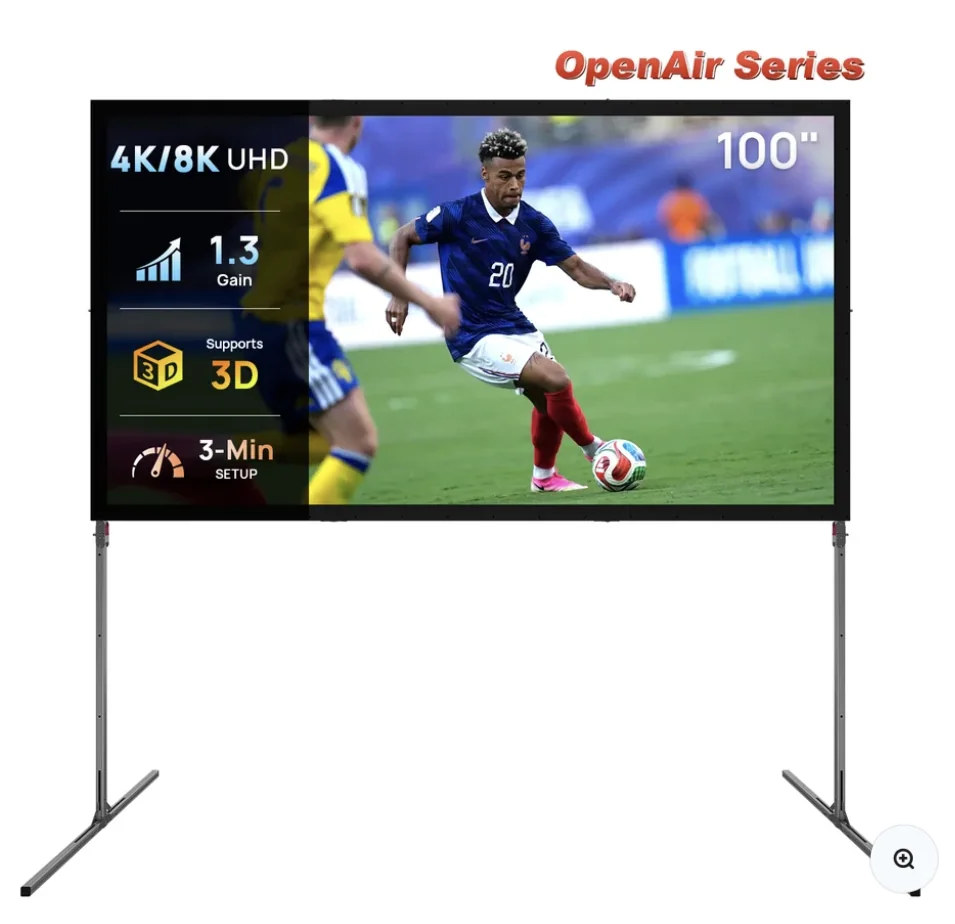
NothingProjector OpenAir Series Alternatives: What to Compare Instead
Relevant alternatives grouped by the job they do differently: folding-frame premium screens, tripod simplicity, lightweight stands and outdoor-specific frames.
The most useful “alternative” is not simply another white rectangle. It is a screen that solves the same constraint differently. For OpenAir shoppers, the major decision axes are UST compatibility, gain, black backing, setup architecture, weight and size range.
Elite Screens Yard Master 2
A close technical comparison: folding frame, 1.3-gain CineWhite UHD-B option, black backing, broad projector compatibility and many sizes up to 140 inches.
Compare specs →Akia 100" Portable Tripod
A simpler 100-inch tripod model with 1.1 gain and 180-degree viewing. The manufacturer explicitly says the compared model is not UST compatible.
Compare specs →JWSIT 120"
A 120-inch, three-layer PVC design with a published 160-degree viewing angle and lighter listed weight than OpenAir 120.
Compare specs →Vamvo 120" Stand Pro
A very lightweight polyester-screen package in the published manual, aimed at portability rather than OpenAir's heavier tensioned-frame approach.
Compare specs →Use these filters before you choose
- If you use UST, eliminate screens that do not explicitly support it or whose geometry cannot stay flat enough.
- If you carry the screen frequently, compare total packed weight—not just screen diagonal.
- If light behind the screen is common, black backing can matter.
- If you host large groups, check both viewing angle and physical frame footprint.
- If setup speed matters, compare the complete anchoring workflow, not only frame unfolding time.