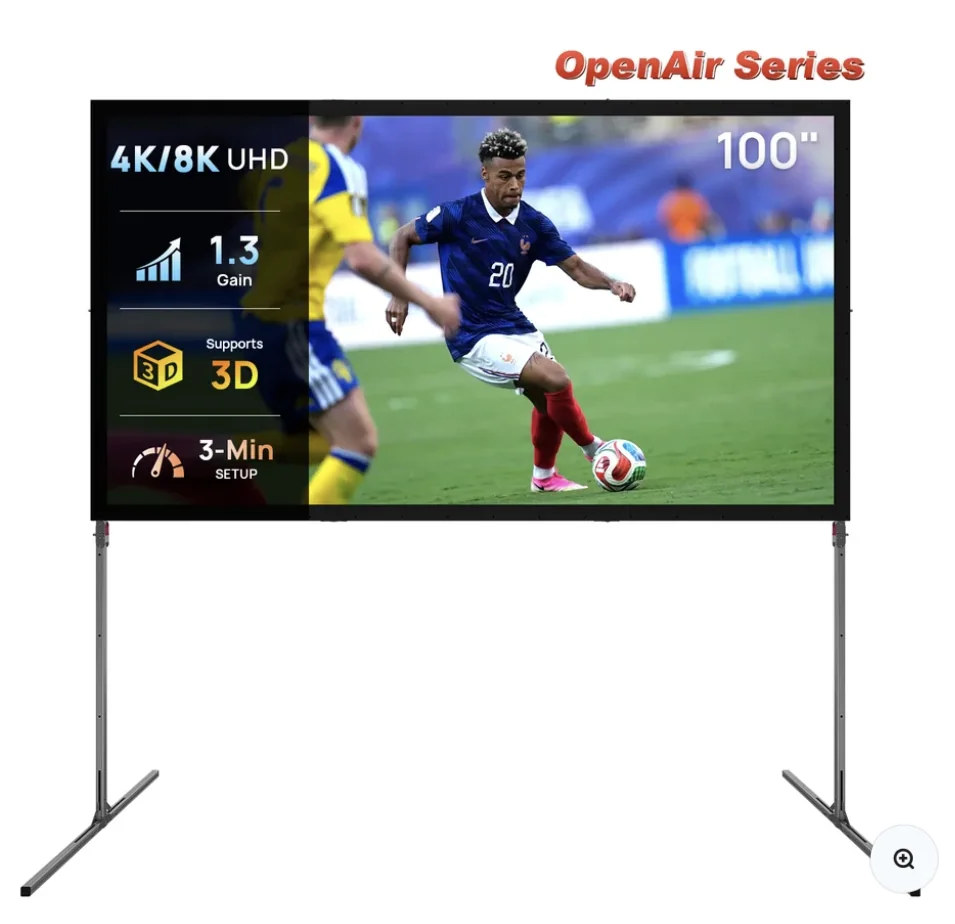
OpenAir Series Features Explained: Gain, Black Backing, Frame & UST Support
A feature-by-feature explanation of the merchant-listed OpenAir Series design and what each specification means in a real outdoor setup.
| OpenAir Series spec | Merchant-listed detail |
|---|---|
| Screen gain | 1.3 |
| Viewing angle | 170° |
| Screen material | 3-layer high-gain PVC with light-blocking black backing |
| Resolution support | 4K / 8K UHD ready |
| Projector compatibility | Standard long throw and ultra short throw (UST) |
| Sizes | 100", 120", 150", 200" |
| Height | Three quick-slide positions |
| Frame | Aluminum alloy + stainless steel |
| Setup claim | Three minutes, tool-free snap-lock system |
1.3 gain
Gain describes screen reflectivity relative to a reference surface. A 1.3-gain screen is designed to return more light toward the audience than a 1.0-gain reference. In practice, projector output, viewing angle, surface uniformity and ambient light still matter.
Three-layer PVC and black backing
The merchant describes the screen as a three-layer high-gain PVC surface with a light-blocking black backing. Black backing is useful when there is stray light behind the screen because it reduces transmission through the material.
170-degree viewing angle
A wide stated viewing angle matters for backyard groups because guests rarely sit in a perfectly centered row. The 170-degree claim suggests the product is intended for broad seating layouts.
Long-throw and UST compatibility
NothingProjector lists both standard long-throw and ultra-short-throw projectors. UST projection is demanding of screen geometry, so careful assembly and tensioning remain important.
Three height positions
The legs offer three quick-slide height positions according to the merchant. That can help when switching between low camping chairs, lounge seating and a more conventional backyard row.
Tool-free folding frame
The merchant describes a snap-lock frame and a three-minute setup process. Treat that time as a manufacturer claim rather than a guaranteed personal setup time; first assembly, anchoring and leveling can reasonably add time.